
Indian benchmark indices Sensex and Nifty rallied in early trade, driven by a positive trend in global markets, cooling crude oil prices following a US-Iran peace deal, and fresh foreign fund inflows.

Indian benchmark indices Sensex and Nifty experienced a significant slump, with the Sensex tumbling 719.08 points, driven by escalating West Asian tensions, a sharp rise in crude oil prices, and a global sell-off in technology stocks.

Water levels were even lower than the 10-year average in 27 reservoirs in eastern India and around 47 in southern India.

Indian oil-marketing companies (OMCs) have incurred LPG underrecoveries of approximately Rs 22,000 crore between March and May 2026, as domestic cooking gas prices failed to keep pace with surging international rates exacerbated by the West Asia crisis, according to a Crisil report.

Matthew Hayden cautions young cricketers against blindly copying Vaibhav Sooryavanshi's fearless batting style, backs Shubman Gill's consistency, and raises concerns over the future of bilateral ODI cricket amid the franchise boom.

Indian benchmark indices, Sensex and Nifty, closed sharply higher, with the Sensex climbing 1,695.40 points and the Nifty surging nearly 2 per cent, driven by a global market rally and a decline in crude oil prices following US President Donald Trump's declaration that his country has ended the war with Iran.

Investors now have 27 passive smallcap funds to choose from 17 index funds and 10 ETFs.

Indian benchmark indices Sensex and Nifty experienced a decline in early trade, mirroring weak global market trends and persistent outflows from foreign institutional investors (FIIs), exacerbated by ongoing geopolitical uncertainties in West Asia.
Indian benchmark indices Sensex and Nifty closed flat, paring early gains due to renewed hostilities between the US and Iran, which unsettled investor sentiment and led to profit booking in metal, oil & gas, and telecom shares.

Rohit Yadav lit up Bhubaneswar's Kalinga Stadium with a career-best throw of 87.05m in the men's javelin throw on the concluding day of the 65th National Inter-State Senior Athletics Championships.

One of the most important provisions this year is that qualifying NEET-PG does not automatically guarantee participation in counselling.

'The real money in India over the coming period is likely to be made in small-cap stocks rather than in the large-cap benchmark names.'

Indian benchmark indices Sensex and Nifty rebounded in early trade, tracking a recovery in global equity markets and an easing of hostilities between Israel and Iran, after a sharp fall in the previous session.

Lionel Messi became the all-time leading scorer in men's FIFA World Cup history on Monday, netting his 17th tournament goal during Argentina's match against Austria.

The remarkable rise of smallcaps reflects the emergence of a broad set of specialised businesses operating in industries where the sectoral tailwinds remain considerably stronger than macroeconomic headwinds, points out Debashis Basu.

Most actively-managed equity mutual fund schemes outperformed their benchmarks despite volatility across domestic equity markets during the past year.
Indian benchmark indices Sensex and Nifty surged significantly in early trade, tracking a global rally fueled by US President Donald Trump's declaration of an end to the war with Iran and a subsequent drop in crude oil prices.
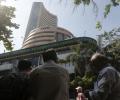
The BSE benchmark traded 44.43 points up at 76,521.93, and the Nifty quoted 17.20 points higher at 24,048.85. Track Stock markets on May 26.
Indian benchmark indices Sensex and Nifty rebounded in early trade, driven by strong buying in blue-chip stocks and positive cues from Asian markets, following a significant selloff in the previous session.

Indian benchmark indices, Sensex and Nifty, closed almost flat in choppy trade as investors remained cautious due to ongoing uncertainty in West Asia, relentless foreign fund outflows, and anticipation of the RBI's monetary policy decision.

US President Donald Trump lauded Prime Minister Narendra Modi's 'calm, cool, killer' persona at the G7 leaders' lunch in France, underscoring the deeply strategic relationship and formidable diplomatic skills of the Indian leader ahead of their crucial bilateral meeting.

Indian benchmark stock indices, Sensex and Nifty, recorded their fourth consecutive day of declines, driven by selling in FMCG, financial, and auto sectors. The downturn is attributed to fresh tensions in the Middle East, uncertainty surrounding the US-Iran 60-day ceasefire, and elevated crude oil prices.
Indian benchmark indices, Sensex and Nifty, closed lower, primarily due to a sharp sell-off in IT stocks, a fresh surge in crude oil prices, and sustained outflows from foreign institutional investors. The Sensex dropped over 300 points, while the Nifty declined by 77.95 points.

IT stocks had their worst first half fall in decades, with the Nifty IT index declining 31% in the January-June 2026 period, its biggest decline in the first six months of a calendar year since 2003.

Indian pacer Prasidh Krishna achieved a historic milestone at Chennai's Chepauk Stadium, taking his maiden five-wicket haul (5/23) in ODIs against Afghanistan. This performance marked the best figures by an Indian bowler at the venue and placed him among an elite group of Indian pacers.

"With the leverage available, I believe the scheme remains reasonably attractive," said P D Singh, India and South Asia Chief Executive Officer, Standard Chartered Bank, regarding the Foreign Currency Non-Resident (Bank) or FCNR (B) deposits.

Indian benchmark indices Sensex and Nifty closed lower for the second consecutive day, driven by investor caution over conflicting geopolitical signals from West Asia and fresh foreign institutional investor (FII) outflows.

90 per cent of institutions recorded no improvement in international student metrics, despite government initiatives such as the Study in India programme, UGC regulations on internationalisation, and efforts to attract foreign students.
Indian benchmark indices Sensex and Nifty closed marginally lower due to profit-taking, following the Reserve Bank of India's decision to keep the repo rate unchanged while lowering its growth expectations for the current fiscal year and forecasting higher inflation.
Indian benchmark indices Sensex and Nifty traded lower amid volatile trends, influenced by escalating geopolitical uncertainties in West Asia and fresh outflows from Foreign Institutional Investors (FIIs).

The Indian stock market's movement this week will be significantly influenced by the outcome of US-Iran talks, global crude oil prices, and the trading activities of foreign institutional investors (FIIs), according to market analysts.
Indian stock market benchmarks, Sensex and Nifty, saw gains in early trading, driven by anticipation surrounding the Reserve Bank of India's monetary policy decision, despite mixed global cues and significant FII outflows.
Indian equity benchmark indices Sensex and Nifty declined in early trade, driven by persistent concerns over the unresolved US-Iran situation and continued outflows from foreign institutional investors.

Indian benchmark indices, the BSE Sensex and NSE Nifty, snapped a four-day losing streak, with the Sensex climbing 382 points, primarily driven by a strong rally in IT sector shares. Major IT firms like TCS, Infosys, and HCL Tech saw significant gains, contributing to the market's recovery.
Indian benchmark indices Sensex and Nifty experienced a significant slump in early trade, mirroring a sharp decline in global equities and a fresh spike in crude oil prices, exacerbated by simmering tensions in West Asia and a global unwinding of the AI-led rally. Track how sensex, Nifty fared on June 8.

'It is a great honour for me if someone says, 'He is like his father.' But I fear I fall short.'

Indian benchmark indices Sensex and Nifty climbed in early trade, driven by a significant drop in crude oil prices following reports of a potential 60-day ceasefire extension between the US and Iran, coupled with positive global market trends and buying in IT stocks.
Indian stock market benchmark indices, Sensex and Nifty, experienced declines in early trade due to escalating tensions between the US and Iran, which led to a surge in crude oil prices and weak global equity trends.

Apple has increased the starting prices of MacBook and iPad models by 20-42 per cent compared to their launch prices across the globe, including India, mainly due to higher memory chip costs. The new price list on Apple India's website shows that the company has increased the price of the MacBook Pro built on the M5 series chip by about 20 per cent.

'Her voice was very rich in timbre and at the same time very soothing.'
